Building RAG Systems for Production: Lessons Learned
Practical insights from deploying Retrieval-Augmented Generation systems in enterprise environments.
SmartTechLabs
SmartTechLabs - Intelligent Solutions for IoT, Edge Computing & AI
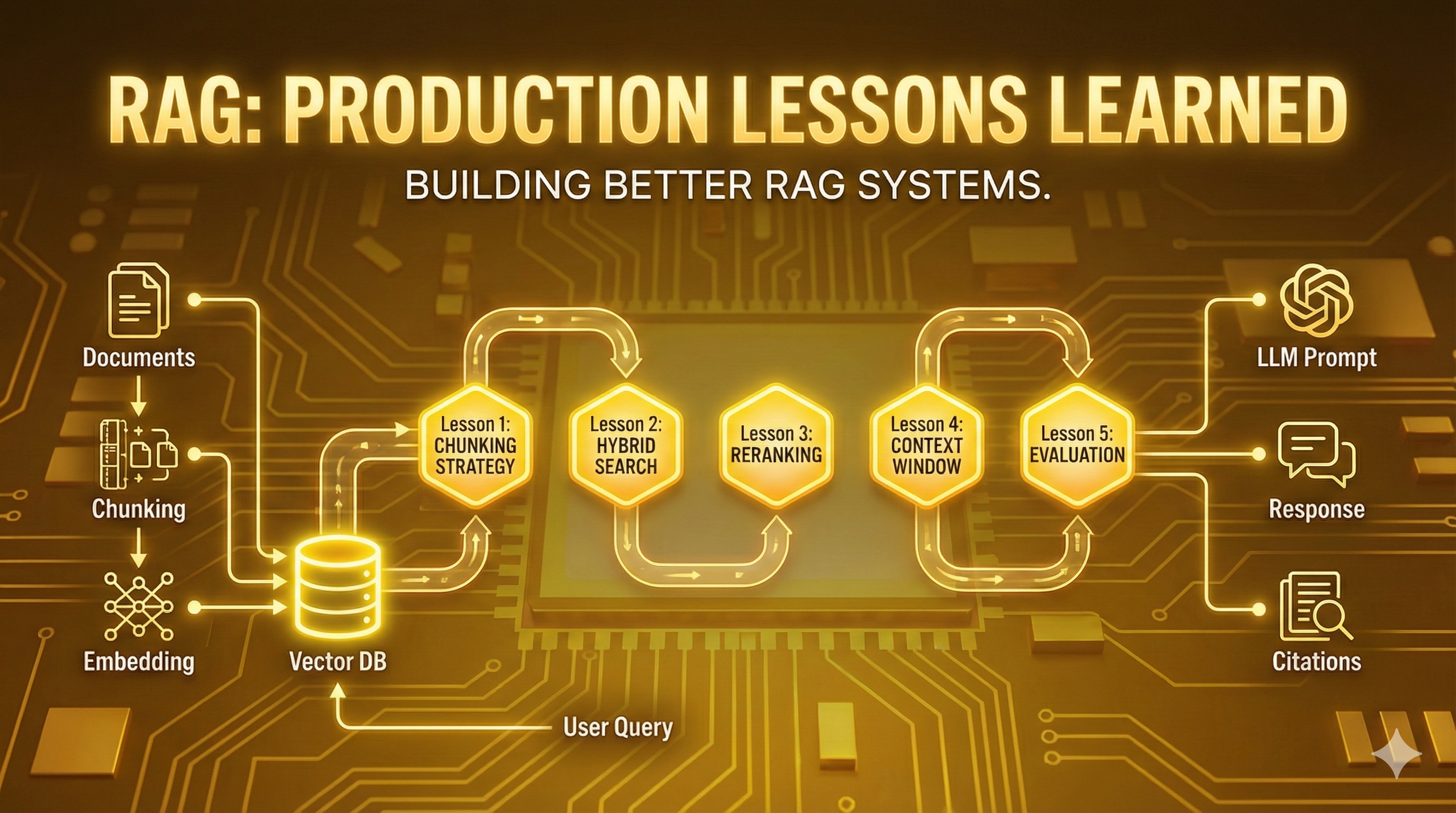
Retrieval-Augmented Generation (RAG) has become the standard approach for building AI systems that need to provide accurate, up-to-date information. After deploying RAG systems for multiple enterprise clients, we’ve gathered key lessons that can help you avoid common pitfalls.
Why RAG Matters
Beyond Basic LLMs
| Benefit | Description | Impact |
|---|---|---|
| Hallucination Reduction | Grounding responses in actual documents | 60-80% fewer factual errors |
| Knowledge Updates | Add documents without retraining | Real-time knowledge refresh |
| Transparency | Cite sources for verification | Increased user trust |
| Cost Efficiency | Avoid expensive fine-tuning | Lower operational costs |
The RAG Pipeline
flowchart LR
    subgraph Ingestion["Document Ingestion"]
        A[Documents] --> B[Chunking]
        B --> C[Embedding]
        C --> D[Vector DB]
    end

    subgraph Retrieval["Query Processing"]
        E[User Query] --> F[Query Embedding]
        F --> G[Vector Search]
        G --> H[Reranking]
    end

    subgraph Generation["Response Generation"]
        H --> I[Context Assembly]
        I --> J[LLM Prompt]
        J --> K[Response]
        K --> L[Citations]
    end

    D -.-> G

    style Ingestion fill:#e0f2fe,stroke:#0284c7
    style Retrieval fill:#fef3c7,stroke:#d97706
    style Generation fill:#dcfce7,stroke:#16a34a
Each component presents its own challenges and optimization opportunities.
Lesson 1: Chunking Strategy Matters More Than You Think
The way you split documents into chunks fundamentally affects retrieval quality.
| Strategy | Description | Best For |
|---|---|---|
| Fixed-Size | Split at character count | Simple documents |
| Semantic | Split at topic boundaries | Complex content |
| Hierarchical | Parent-child relationships | Context expansion |
| Overlapping | Chunks share boundaries | Preserving context |
Key Recommendations
- Semantic chunking often outperforms fixed-size chunking
- Overlap between chunks (10-20%) helps preserve context
- Metadata attached to chunks (source, date, section) improves filtering
- Hierarchical chunking enables context expansion when needed
Lesson 2: Hybrid Search is Usually Better Than Pure Vector Search
Key Insight
| Search Type | Strengths | Weaknesses |
|---|---|---|
| Vector Search | Semantic understanding | May miss exact terms |
| Keyword Search | Exact matching | No semantic understanding |
| Hybrid | Best of both | More complex to implement |
| |
Lesson 3: Reranking is Worth the Latency Cost
| Stage | Optimization Goal | Typical Latency |
|---|---|---|
| Initial Retrieval | Recall (find all relevant) | 10-50ms |
| Reranking | Precision (rank best first) | 50-100ms |
| Final Selection | Quality balance | Instant |
Initial retrieval optimizes for recall (finding all relevant documents), but reranking optimizes for precision:
- Use a cross-encoder model to re-score top candidates
- The latency cost (50-100ms) is usually acceptable for enterprise applications
- Quality improvements of 10-20% on relevance metrics are typical
Lesson 4: Context Window Management
More Isn't Always Better
| Approach | Pro | Con |
|---|---|---|
| Stuff All | Simple implementation | Diluted signal |
| Top-K | Focused context | May miss info |
| Dynamic | Adapts to query | More complex |
| Summarized | Compressed info | Loss of detail |
Lesson 5: Evaluation is Non-Negotiable
You can’t improve what you don’t measure.
| Metric Category | Metrics | Target |
|---|---|---|
| Retrieval Quality | Precision, Recall, MRR | MRR >0.7 |
| Generation Quality | Accuracy, Relevance, Groundedness | >90% accurate |
| User Feedback | Satisfaction, Helpfulness | >4/5 rating |
| System Health | Latency, Error rate | p95 <2s |
Evaluation Framework
- Build a golden dataset of questions with expected answers
- Measure both retrieval quality and generation quality
- Run automated evaluations in CI/CD pipelines
- Collect user feedback for continuous improvement
Production Considerations
Scaling
| Component | Scaling Challenge | Solution |
|---|---|---|
| Vector DB | Index size growth | Sharding, clustering |
| Embeddings | Throughput limits | Batching, caching |
| LLM Calls | API rate limits | Queuing, load balancing |
| Storage | Document corpus | Tiered storage |
Monitoring
Track these metrics in production:
| Metric | p50 Target | p99 Target |
|---|---|---|
| Retrieval Latency | <100ms | <500ms |
| Embedding Latency | <50ms | <200ms |
| LLM Response | <2s | <5s |
| End-to-End | <3s | <8s |
Security
| Concern | Mitigation |
|---|---|
| Access Control | Document-level permissions |
| Audit Logging | Query and response tracking |
| PII Handling | Redaction in pipeline |
| Rate Limiting | Prevent abuse |
Implementation Checklist
- Data Pipeline: Document ingestion and chunking strategy
- Vector Store: Select and configure vector database
- Retrieval: Implement hybrid search with reranking
- Generation: Prompt engineering and context assembly
- Evaluation: Build golden dataset and automated tests
- Monitoring: Set up observability and alerting
- Security: Implement access control and audit logging
Conclusion
RAG systems are deceptively simple in concept but require careful engineering to work well in production. The key is to treat RAG as a complete system rather than just connecting a vector database to an LLM.
Start with a strong evaluation framework, iterate on each component, and monitor everything in production. The investment in infrastructure pays off in system reliability and user trust.
Working on a RAG implementation? Reach out to discuss your specific challenges.
SmartTechLabs
Building Intelligent Solutions: IoT, Edge Computing, AI & LLM Integration
Related Articles
RAG Systems
Retrieval-Augmented Generation RAG systems combine the reasoning capabilities of Large Language …
Read moreAI Agents
Autonomous AI Agents AI agents go beyond simple question-answering. They can reason about problems, …
Read moreCodex-V Knowledge Engine
Your Personal Technical Knowledge Engine Codex-V is a local-first knowledge management system …
Read more