RAG Systems
Retrieval-Augmented Generation systems that combine the power of LLMs with your organization's knowledge base.
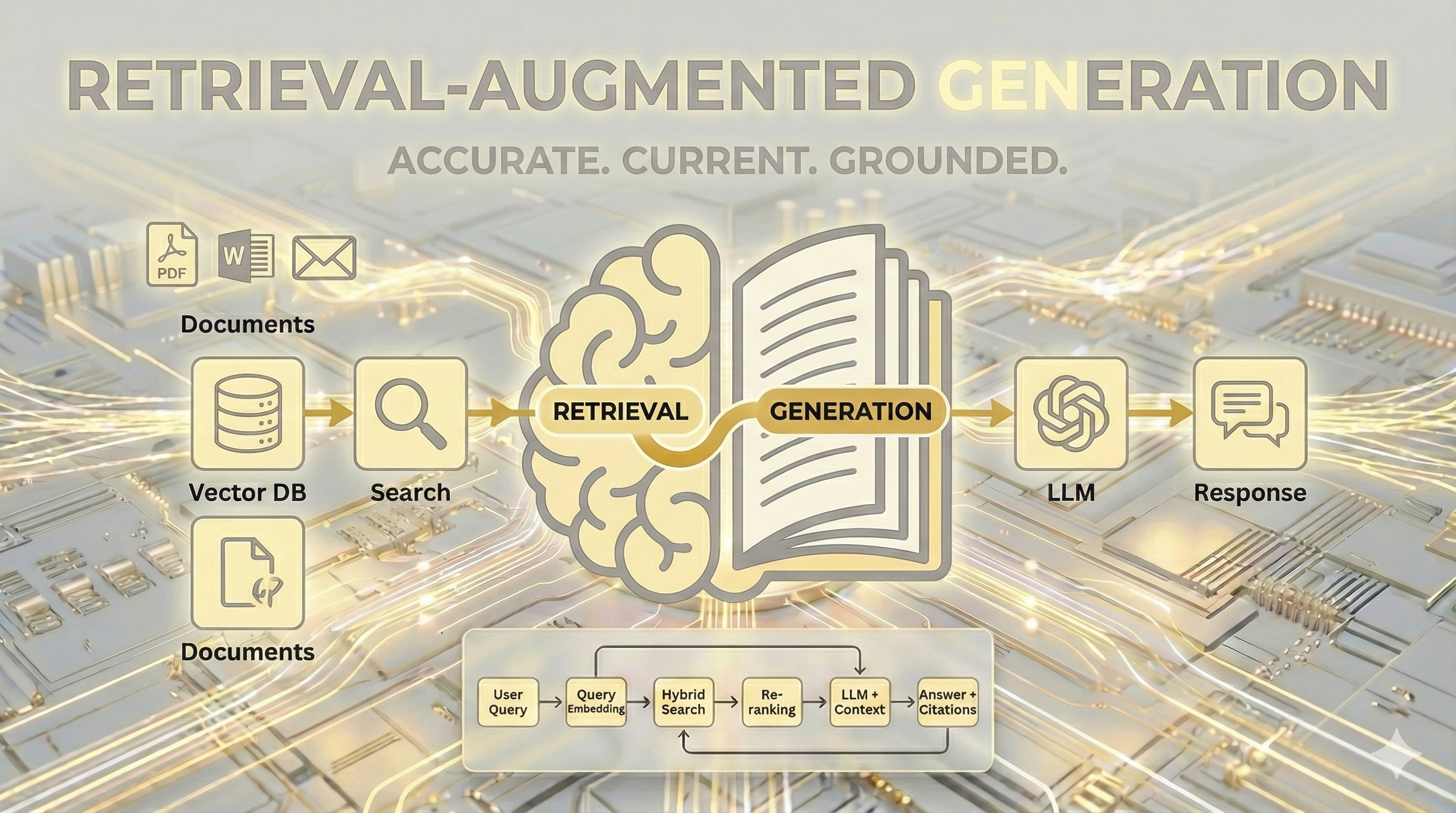
Retrieval-Augmented Generation
RAG systems combine the reasoning capabilities of Large Language Models with accurate retrieval from your knowledge base. The result: AI that provides relevant, accurate, and up-to-date information grounded in your data.
Why RAG?
- Accuracy: Answers grounded in your actual documents and data
- Currency: No retraining needed when your knowledge updates
- Transparency: Citations and source references for every answer
- Privacy: Your data stays in your infrastructure
- Cost-Effective: Leverage existing LLMs without expensive fine-tuning
RAG is Part of a Broader Solution
Beyond Simple Q&A
A production RAG system is rarely just “embed documents and query.” Successful implementations integrate:
- Data Pipelines: Continuous ingestion, processing, and indexing of new content
- Quality Assurance: Document validation, deduplication, and freshness management
- User Experience: Chat interfaces, feedback loops, and conversation memory
- Monitoring & Analytics: Usage tracking, query analysis, and retrieval quality metrics
- Access Control: Role-based permissions and document-level security
- Hybrid Approaches: Combining RAG with agents, structured data queries, and workflow automation
The RAG Process
flowchart LR
    subgraph Ingestion["📥 Document Ingestion"]
        A[Documents] --> B[Chunking]
        B --> C[Embedding]
        C --> D[(Vector DB)]
    end

    subgraph Query["🔍 Query Processing"]
        E[User Query] --> F[Query Embedding]
        F --> G{Hybrid Search}
        G --> H[Semantic Search]
        G --> I[Keyword Search]
    end

    subgraph Retrieval["📚 Context Assembly"]
        H --> J[Re-ranking]
        I --> J
        J --> K[Top-K Selection]
        K --> L[Context Window]
    end

    subgraph Generation["🤖 Response"]
        L --> M[LLM + Context]
        M --> N[Answer + Citations]
    end

    D --> G

    style Ingestion fill:#e0f2fe,stroke:#0284c7
    style Query fill:#fef3c7,stroke:#d97706
    style Retrieval fill:#dcfce7,stroke:#16a34a
    style Generation fill:#f3e8ff,stroke:#9333ea
Our RAG Architecture
They are all different
We build production-grade RAG systems with:
Document Processing
- Multi-format ingestion (PDF, Word, HTML, Markdown, Email)
- Intelligent chunking strategies (semantic, recursive, document-aware)
- Metadata extraction and enrichment
- Table and image extraction with OCR
- Version tracking and incremental updates
Vector Storage & Search
- PostgreSQL with pgvector for integrated solutions
- Dedicated vector databases (Qdrant, Weaviate, Pinecone, Milvus)
- Hybrid search combining semantic and keyword matching
- Multi-tenant architectures with data isolation
- Filtering by metadata, date ranges, and access permissions
Retrieval Optimization
- Query expansion and reformulation
- Cross-encoder re-ranking for precision
- Contextual compression to maximize relevant information
- Parent-child document retrieval for full context
- Multi-step retrieval for complex queries
Response Generation
- Multiple LLM support (OpenAI, Anthropic, local models)
- Structured output generation (JSON, tables, summaries)
- Source citation with page/section references
- Confidence scoring and uncertainty detection
- Streaming responses for better UX
Current Trends & Advanced Techniques
The RAG landscape is evolving rapidly. We implement cutting-edge approaches:
Agentic RAG
Combining retrieval with autonomous agents that can:
- Decide when to retrieve vs. use existing context
- Perform multi-hop reasoning across documents
- Call external tools and APIs when needed
- Self-correct based on retrieved information
Graph RAG
Enhancing retrieval with knowledge graphs:
- Entity extraction and relationship mapping
- Graph-based context expansion
- Combining structured and unstructured knowledge
- Better handling of complex, interconnected topics
Adaptive Chunking
Moving beyond fixed-size chunks:
- Semantic chunking based on content structure
- Document-aware splitting (respecting sections, paragraphs)
- Late chunking with contextualized embeddings
- Dynamic chunk sizing based on content density
Evaluation & Optimization
Systematic quality improvement:
- Automated retrieval quality metrics (MRR, NDCG, recall)
- LLM-as-judge for answer quality assessment
- A/B testing of retrieval strategies
- Continuous feedback integration
Project Highlights
Internal Documentation Center
Case Study
Challenge: A client needed to make thousands of technical PDF documents searchable and queryable through natural language, enabling engineers to quickly find relevant specifications, procedures, and guidelines.
Solution:
- Automated PDF ingestion pipeline with intelligent text extraction
- Table and diagram recognition for technical content
- Semantic search across the entire document corpus
- Conversational interface with source citations
- Role-based access control for sensitive documents
Results: Reduced documentation lookup time from hours to seconds, with accurate source references for compliance requirements.
Intelligent News & Trend Analysis
Case Study
Challenge: A client needed to stay informed about industry developments but was overwhelmed by the volume of newsletters, alerts, and updates arriving via email from various sources.
Solution:
- Automated email ingestion from curated source lists
- Content extraction and categorization
- Daily trend reports with key insights and summaries
- Growing knowledge base of historical intelligence
- Conversational interface to query the accumulated knowledge
- Topic tracking and alert generation for specific interests
Results: Transformed information overload into actionable intelligence, with executives receiving concise daily briefings and the ability to deep-dive into any topic through natural conversation.
Use Cases
- Enterprise Knowledge Base: Internal documentation, policies, procedures
- Customer Support: Product manuals, FAQs, troubleshooting guides
- Legal & Compliance: Contracts, regulations, case law
- Research & Intelligence: Scientific papers, market reports, competitive analysis
- Technical Documentation: API docs, specifications, engineering standards
- HR & Operations: Employee handbooks, onboarding materials, process guides
Integration Options
We integrate RAG into your existing workflows:
- REST API Endpoints: Direct integration with your applications
- Slack/Teams Bots: Knowledge access in your communication tools
- Web Chat Interfaces: Embeddable widgets for websites and portals
- Email Assistants: Automated responses and research support
- Mobile Apps: On-the-go access to your knowledge base
- n8n/Zapier Workflows: Automated knowledge-driven processes
Technology Stack
| Component | Options |
|---|---|
| Embeddings | OpenAI, Cohere, BGE, E5, local models |
| Vector DB | pgvector, Qdrant, Weaviate, Pinecone, Milvus |
| LLMs | GPT-4, Claude, Llama, Mistral, local deployment |
| Orchestration | LangChain, LlamaIndex, custom pipelines |
| Infrastructure | Docker, Kubernetes, serverless |
Ready to unlock your organization’s knowledge? Let’s discuss your RAG implementation.
Related Content
Codex-V Knowledge Engine
Your Personal Technical Knowledge Engine Codex-V is a local-first knowledge management system …
Building RAG Systems for Production: Lessons Learned
Retrieval-Augmented Generation (RAG) has become the standard approach for building AI systems that …
AI Agents
Autonomous AI Agents AI agents go beyond simple question-answering. They can reason about problems, …