Codex-V Knowledge Engine
A local-first, privacy-centric knowledge management system that transforms scattered technical content into an intelligent, searchable second brain.
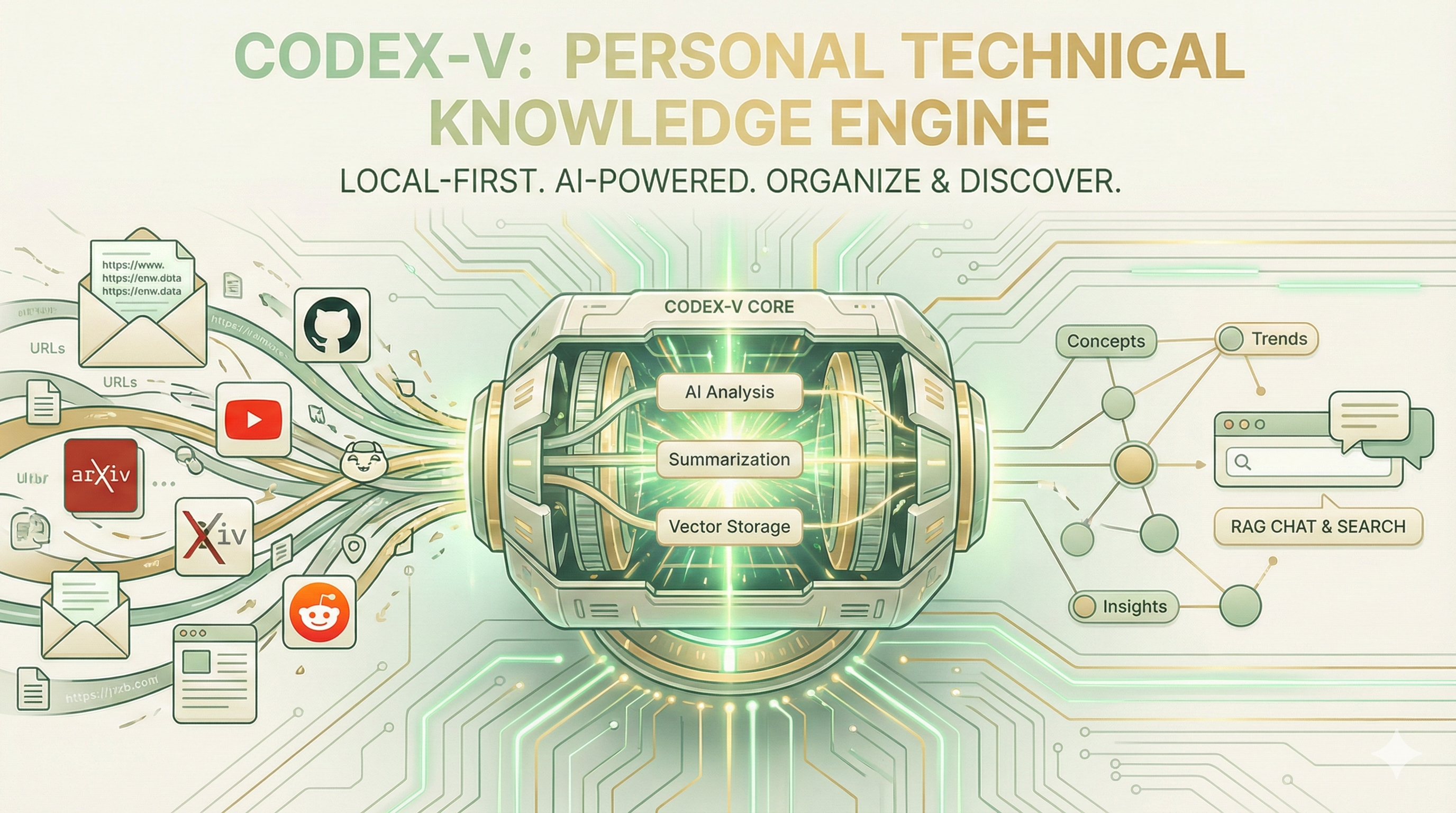
Your Personal Technical Knowledge Engine
Codex-V is a local-first knowledge management system designed for software engineers and technical professionals. It automatically ingests, analyzes, and organizes technical content from diverse sources into a searchable knowledge base with AI-powered chat capabilities.
The Problem We Solve
Information Overload
- Bookmarks saved but never revisited
- Links emailed to yourself, buried in your inbox
- YouTube tutorials watched but details forgotten
- Research papers downloaded but never searchable
- GitHub repos starred but their purpose forgotten
Codex-V transforms this chaos into an intelligent, queryable knowledge base.
How It Works
flowchart LR
    subgraph Discovery["1. Discovery"]
        A[Email with URLs] --> B[IMAP Polling]
        C[Manual URL] --> B
        B --> D[URL Classification]
    end

    subgraph Extraction["2. Extraction"]
        D --> E{Source Type}
        E -->|GitHub| F[API + README]
        E -->|YouTube| G[Transcript]
        E -->|ArXiv| H[LaTeX/PDF]
        E -->|Blog| I[Readability]
        E -->|Reddit| J[Post + Comments]
    end

    subgraph Analysis["3. AI Analysis"]
        F & G & H & I & J --> K[Local LLM]
        K --> L[Summary]
        K --> M[Concepts]
        K --> N[Relevance]
    end

    subgraph Storage["4. Knowledge Base"]
        L & M & N --> O[PostgreSQL]
        O --> P[pgvector]
        P --> Q[Semantic Search]
    end

    style Discovery fill:#e0f2fe,stroke:#0284c7
    style Extraction fill:#fef3c7,stroke:#d97706
    style Analysis fill:#dcfce7,stroke:#16a34a
    style Storage fill:#f3e8ff,stroke:#9333ea
The Workflow
- Send yourself an email with links to interesting content
- Codex-V polls your inbox and discovers new URLs
- Specialized extractors fetch content based on source type
- Local LLM analyzes and generates summaries, concepts, relevance scores
- Content is embedded and stored in a vector database
- Search semantically or chat with your knowledge base
Key Features
Multi-Source Ingestion
Supported Sources
| Source | Extraction Method | Special Features |
|---|---|---|
| YouTube | Transcript API / Whisper | Timestamped chunks, deep links to moments |
| GitHub | API + selective cloning | README, stars, language, file analysis |
| ArXiv | LaTeX source or PDF | Math preservation, author/abstract extraction |
| JSON API | Post + top comments with consensus analysis | |
| Blogs | Playwright + Readability | Cookie wall bypass, paywall support via cookies |
| Documentation | Browser rendering | Full page extraction with code blocks |
AI-Powered Analysis
Every piece of content is analyzed by a local LLM to generate:
- Concise Summary: 2-3 sentences capturing the key value
- Concept Tags: Automatically extracted topics and technologies
- Relevance Score: How well it matches your interests
- Key Insights: Actionable takeaways
Semantic Search & RAG Chat
Find by Meaning, Not Keywords
Search: “How do I implement mutex locking in Go?”
Chat Response: “Based on your saved YouTube video ‘Concurrency in Go’ and the GitHub repo ‘awesome-go-patterns’, mutex locking involves…”
[Sources cited with links and timestamps]
Trend Detection & Insights
Codex-V analyzes your ingestion patterns to identify:
- Emerging Interests: Topics appearing more frequently
- Key Themes: Dominant concepts in your recent reading
- Learning Patterns: How your focus evolves over time
Email Group Detection
When an email contains multiple related URLs (paper + code + demo), Codex-V automatically groups them together, making it easy to see the full context of related resources.
Privacy-First Architecture
Your Data Never Leaves Your Machine
Local-Only Components
- PostgreSQL + pgvector: All data stored locally
- Local LLM via Ollama/LM Studio: No API calls to external services
- Local Embeddings: sentence-transformers running on your machine
- Desktop App: Native Wails application, no browser required
Optional External Services
- Authenticated scraping: Uses your browser cookies for paywalled content
- Publishing LLM: Optional high-quality model for content generation
Technology Stack
| Component | Technology | Purpose |
|---|---|---|
| Frontend | Wails v2 + Vue 3 + TailwindCSS | Native desktop application |
| Backend | Python FastAPI | API, content extraction, LLM orchestration |
| Database | PostgreSQL 17 + pgvector | Storage and vector search |
| LLM | Ollama / LM Studio | Local inference (Nemotron, Qwen, Llama) |
| Embeddings | sentence-transformers | all-MiniLM-L6-v2 (384 dimensions) |
| Transcription | faster-whisper | Local GPU-accelerated transcription |
| Browser | Playwright | Authenticated and JavaScript-rendered content |
Content Studio
Beyond knowledge management, Codex-V includes a Content Studio for technical content creators:
- Topic Proposals: AI analyzes recent ingestions and suggests blog/post topics
- Content Generation: Creates publish-ready blog posts and social threads
- Source Attribution: Links back to the knowledge that inspired the content
- Publishing Pipeline: Integration with Hugo, social platforms, and more
Use Cases
For Software Engineers
- Capture interesting repos, tutorials, and documentation
- Search your personal knowledge during development
- Track emerging technologies in your field
For Researchers
- Organize papers, preprints, and technical blogs
- Query across your reading history
- Generate literature review summaries
For Technical Writers
- Build a knowledge base of source material
- Generate content ideas from recent reading
- Maintain attribution to original sources
For Team Leads
- Curate learning resources for your team
- Track industry trends and emerging technologies
- Build institutional knowledge repositories
Getting Started
Quick Setup
Prerequisites
- Docker Desktop - For PostgreSQL with pgvector
- Ollama -
ollama pull nemotronor your preferred model - Python 3.11+ - For the backend services
Installation
| |
Configuration
- Add your email source in Settings > Email Sources
- Configure LLM endpoint (Ollama default:
http://localhost:11434/v1) - Send yourself an email with interesting URLs
- Watch Codex-V build your knowledge base
Roadmap
Current Features
- Multi-source ingestion (YouTube, GitHub, ArXiv, Reddit, blogs)
- Local LLM analysis and summarization
- Semantic search with pgvector
- RAG chat with source citations
- Trend detection and daily insights
- Content Studio for topic proposals
Planned Features
- Browser extension for one-click capture
- Mobile companion app for search
- Team collaboration features
- Export to Obsidian/Notion formats
- Advanced graph visualization
Ready to build your second brain? Contact us for a demo or check out the GitHub repository.
Related Content
RAG Systems
Retrieval-Augmented Generation RAG systems combine the reasoning capabilities of Large Language …
Building RAG Systems for Production: Lessons Learned
Retrieval-Augmented Generation (RAG) has become the standard approach for building AI systems that …
Local LLMs
Local LLM Deployment Keep your data private with on-premise language models. We help organizations …